Showing posts with label Universal Basic Income. Show all posts
Friday, September 21, 2018
Establishing an American Citizen’s Dividend - UBI
A Universal Basic Income is NOT Free Money. It is the birthright of American Citizenship and Sacrifice and quite possibly a pathway to a new empowered and entrepreneurial age.
The good folks I live with in the shadow of Rattlesnake Ridge have always been a very hardy lot and it takes quite a bit to shake their cool. For example, long before the Gig economy was “A Thing” as folks say these days, these folks were adding a gig here and a gig there to keep their heads above water. They don’t complain about it, they just do it.
But in recent years something has happened, even here. The world is shifting beneath our feet. Dramatic changes are sweeping through our economy. Each year the changes accelerate. Americans are working longer and harder and yet they continue to fall further behind. For 45 years, since 1973, real wages and the wealth of our citizens have been declining. The growing, savage disparity of wealth in our country challenges our faith in the capitalist system and our Democratic ideals. Today, more than any time during my life, we are faced with the question of whether the American system of government will survive. Whether we will continue to be the beacon of hope we once were and the leaders of the free world. . . whether we will be the masters of change or its victims.
This column addresses what some call UBI or Universal Basic Income. In a nutshell UBI is a proposal to provide every American citizen who attains an agreed upon age (18 or 21 under most suggested versions) with a monthly income. For the sake of this piece let’s assume it is $1,000 per month. Every month, every qualifying American citizen would receive a check, or a wire deposit for $1,000 no matter where they fall on the income ladder. Rich, poor, working class, middle class, even the 1% would receive a payment.
No bureaucrat would supervise how it is used and no one could take it away from you. No welfare worker could claw it back because you earned too much at your job, although those at the highest income levels would probably pay most of it back in taxes and certainly wouldn’t really notice it.
It is a Dividend paid for simply being an American. For being the inheritors of 500 years of sacrifice, voluntary and involuntary, by those who came before us and the sweat of our own brows and the taxes we have paid.
It is reparations for 200 plus years of slavery if you are an African American; reparations for the theft of your land if you are Native American; for the theft of your wealth and freedom if you are a Japanese American whose family was incarcerated in internment camps during World War II; for years of low-paying wages that subsidized the American economy if your family arrived as immigrants and for years of paying taxes that built roads, bridges, airports and schools that educated our workforce and carried the products of businesses to markets.
It is the public benefit of providing a court system, purchased with our taxes, where justice can be found and for Intellectual property laws that protect the millions of patents that have rocketed so many Americans into prosperity.
It is the equity value of research done by the Department of Defense, NASA, DARPA, NIH and an alphabet soup of taxpayer funded agencies that have created everything from the Internet to GPS and Touch Screen Technology all being used today to the benefit of Apple, Google, Uber and thousands of companies in our high-tech society.
Having read these last few paragraphs you can understand why the term Universal Basic Income somehow falls short of describing the concept, and the notion that it is “free money” is, on its face, absurd. It is a recognition that we have failed for more than 200 years to recognize the role played by every one of our citizens collectively in the accumulation of wealth that has made America the most prosperous nation on the face of the earth. It is why I have chosen to call this an American Citizens Dividend.
If capitalism is to survive – and it must – because it is the only operating system that has been shown to work, we must create a capitalism that recognizes that the generation of wealth in a healthy economy comes from inputs from everyone and the benefits of that wealth creation should be shared by all of those who have contributed. In other words, as I have said before, we are all victims, we are all due reparations, we are all in this together.
Today, the American political and economic systems are in twin, enfolding crises.
More than 90% of job growth during the past two years has been contract work, without any safety net or benefits, including unemployment insurance if layoffs occur; 47% of millennials, who make up the largest portion of the workforce, according to surveys, are engaged in some level of freelance work, most in order to make ends meet.
Many researchers project that half of the working U.S. population will move into the gig economy within the next five years, without the safety net of benefits or unemployment or disability insurance.
A majority of low-wage employers are now requiring employees to sign non-compete agreements as a condition of employment. A worker at MacDonalds, who finds himself/herself with the opportunity to move to Burger King for two dollars an hour more must now calculate into their decision-making the very real possibility that her employer will sue to prevent her from taking the job.
The decline in real wages since 1973 has crippled the spending power of consumers. In a consumer driven society, we are witnessing the early signs of the potential extinction of the consumer. After all, the 1% can only buy so many pairs of socks, or pants, or skirts.
We have moved to Workforce 2.0 in the global economy, but our governance is still stuck in Democracy 1.0 and capitalism 1.0 and that is a real and growing problem. What will happen if we are unprepared for the day when 50% of today’s jobs are performed by robots and computer programs? What will happen to both the Amazon’s and the small businesses dependent upon consumers when all of their income goes to meeting basic needs and there is nothing left for purchasing items that are “luxuries” like socks and shoes?
In the coming months, more and more people will be talking about enacting a Universal Basic Income for every American to help them meet their basic needs. The Basic Income is not a new idea. It has been around since it was first suggested by Thomas Paine – yes that Thomas Paine. It was quite nearly passed into law during the tenure of Richard Nixon at his urging, supported by conservative economist Milton Friedman, liberal economist Robert Reich, libertarian Charles Murray and a list of distinguished thinkers from across the political spectrum. Of course, it has its detractors as well.
For the sake of a good old American discussion, take a deep breath and open your mind to the possibilities. This is only an introduction. Intended to present some of the many arguments for it. People of good will can come down on either side of this. I happen to believe that it may be the solution to America’s most long-standing problem, the wealth gap, as well as a few of the new ones like the Gig Economy and the coming of the robots. Let’s explore some of the more interesting ideas around it.
The Poverty Trap
Of course, the cost of enacting a Citizens Dividend would not be cheap, estimates put the cost at about 1.5-2 trillion dollars, but neither is the social safety net that we have constructed in America and the bureaucracy needed to support it.
Being poor is no picnic no matter where you live. However, the consequences may vary from region to region.
According to the latest data, more than 15% of Americans live in poverty. As many as 100 million more, fully one third of our people, live only one paycheck or one health emergency or car meltdown from it.
Over the years the United States has developed, piece by piece, an elaborate and costly social safety net intended to help people who live in this precarious position. Yet, despite this, the numbers continue to grow. Today the number of people living at or near the poverty line is almost as high as it was when our nation launched its War on Poverty during the Johnson Administration. In fact, according to one study by the US Census Bureau, the number of people in poverty in the US has only seen an improvement of about 1.5% despite spending 20 trillion dollars on anti-poverty programs since 1966. Every year we spend nearly a trillion dollars on anti-poverty programs, yet we still have one of the highest rates of poverty in the developed world.
Before you assume that I am going to declare that the War on Poverty was a failure let me assure you that it was not. Medicare, Medicaid, Head Start, Special Education, The Higher Education Act, all of these programs moved millions of Americans out of poverty or, at worst, made poverty more bearable as a result of those programs but as the number of people in our country grew since the 1960s poverty rates remained relatively unchanged. The greatest beneficiaries of the War on Poverty were the elderly. The nexus of Social Security, Medicare and Medicaid nearly eliminated poverty among the elderly in the early years of the Great Society, but the growing inequality of income threatens to reverse that today.
Today the social safety net has become a poverty trap and both the right and the left are equally responsible for that. Ironically, both have the best of intentions. But the best of intentions has led to further ensnaring lower income people in a poverty trap. The advocates of the right – they are usually the ones who have the word “Liberty” somewhere in their name – Ironically criticize the social safety net for discouraging work and marriage. I say ironically because they were the source of the restrictions that make it nearly impossible to work your way out of poverty and who punish families who try to stay together by denying them benefits. They do it with a punishing bureaucracy that makes moving up the income ladder harder and harder by clawing back benefits every time an impoverished person tries to better their lives.
The left does it by nannying the poor, treating them as if they were not capable of making their own decisions and taking responsibility for their decisions. The newest nutty idea for this is the “guaranteed job.” The idea that a new government bureaucracy should be established that guarantees a job for every American and creates one where it cannot be found. This is just further evidence for the culpability of both the left and the right in the creation of a poverty trap.
Every American who wants a job – and most do – should be able to get a job, a good job. A good job is a job that you can say no to because it does not provide either the level of pay or the benefits or the challenge that you believe should be associated with it. An American Dividend would allow people, even the poor, to say no to a job that takes advantage of them. We would be able to consolidate most of the programs that compose the social safety net into a bureaucrat free American Dividend. One simple check every month. We would also be able to eliminate the endless fight over the minimum wage. Employers would offer a good wage or they would fail to get workers who had the security of the American Dividend to fall back on while they looked elsewhere.
So Many Needs, So Little Money
Listen to every candidate and you will find some program or need that you can agree with but put them all together and we help some and provide programs for those who don’t want or need them, and in the end, we just don’t have the money to enact one entitlement after another.
Take Bernie’s idea to provide free tuition for public college. While I fervently believe that we can do much more to make public institutions of higher education strong, I am just as enthusiastic about strengthening private colleges. In fact, if you look at public colleges and universities in this country they are almost invariably investing more, building more, upgrading more and providing greater benefits to faculty and staff than most private colleges, especially the smaller ones, can possibly afford. They have the advantage of covering a large portion of their budget with taxpayer dollars, they have the ability to borrow at lower rates to build new buildings or to renew old ones, by virtue of the fact that they can float bonds through a capital budget process.
On the other hand, there are hundreds of small private colleges that are providing extraordinary educational value to students that would benefit greatly if students were able to make their choice of schools based on what would provide the greatest value to them, without having to face the unlevel playing field where public colleges and universities could offer free tuition.
Creating new public policy is always a challenge and the unintended consequences are often the greatest danger. Free tuition to public colleges and universities would very likely be the death knell for hundreds of small colleges who are right now providing a more affordable alternative to tens of thousands of students. My son Zach attended a very fine little private college in Prescott, Arizona, for half what he would have paid in tuition at my alma mater UNH. I’m afraid his alma mater would be gone after the first year of a free public college tuition program.
An American Dividend or UBI gives every citizen the freedom to choose from a smorgasbord of options. If they need tuition to improve their skills or attend college, they can use it for just that purpose. If they need child care, it can be used for that. If they need to take some unpaid leave for any purpose they can rely on it for that purpose. This is why the Dividend is without strings and why it is paid to everyone. For those who don’t need it, they can use it to support local charity efforts that fill other important niches.
A New Age of Empowerment and Entrepreneurship
Now I won’t tell you that abusive husbands (or wives) will stop abusing their spouses. But I will tell you that their spouses would not be entrapped in an abusive marriage without an option because the UBI/American Dividend would allow them to leave – here’s where I would like to use a term that my publisher won’t permit, let’s call it “Me Too” money because it sort of rhymes with “Me Too,” It’s the money that frees them from an abusive dependence.
The gig economy is here to stay, in 20 years very few of the jobs that exist will come with a social safety net. But the UBI/American Dividend can serve that function. Furthermore, as more and more jobs become automated we will need more and more entrepreneurial ideas for solving problems that also generate new jobs.
Many of the folks who advocate for this insist that it will usher in a new era of entrepreneurship, because the cushion provided to entrepreneurial minded people will give them the opportunity to take risks. They point to people like Steve Jobs and remind us that if he was working a minimum wage job 40 hours a week or more, he would never have been able to launch Apple but he had a UBI – a roof over his head and three squares a day provided by his parents. By that measure, of course, a lot of young people today already have a UBI, provided by their parents. But you get the picture.
There are a hundred more good reasons that we should adopt the idea of giving every American an American Dividend. Coupled with a Mandatory National Service Requirement it would go a long way to healing the ills in our country.
It’s also the recipe for beating the Democrats in 2020 – without Donald Trump of course – because it’s unlikely the Democrats will have the courage to offer it as a solution to the wage disparity. They are too tied to organized labor and the welfare state bureaucracy. Alas, it’s equally unlikely that any Republican will either. Maybe someone will surprise me . . . are you listening Beto? Jeff Flake? Governor Kasich? I’d suggest a fusion ticket with a Democrat and a Republican. Don’t let the partisans keep you from taking the risk.
About Wayne D. King: Wayne King is an author, artist, activist and recovering politician. A three term State Senator, he was the 1994 Democratic nominee for Governor and most recently the CEO of MOP Environmental Solutions Inc., a public company in the environmental cleanup space. His art is exhibited nationally in galleries and he has published three books of his images. His most recent novel “Sacred Trust” a vicarious, high voltage adventure to stop a private powerline is available on Amazon.com. He lives in Rumney at the base of Rattlesnake Ridge where he flies both the American and Iroquois flags proudly. His website is: http://bit.ly/WayneDKing
Coming soon! The Radical Centrist Podcast!
Monday, April 30, 2018
The Future of Work: The Gig Economy is Here to Stay.
The Gig economy is the term on the tip of the tongues of commentators and analysts these days. It’s a very broad term that describes both the increasing tendency of employers to hire independent contractors and short term workers rather than add new full time employees, and their accompanying taxes and benefits, to their workforce. It also describes a range of individuals who, by choice or necessity, build an income around work that is self-directed and without both the benefits and the downsides of a traditional job. A gig job may be a sole source of income or performed in addition to a traditional job that doesn’t generate the income necessary to either the needs or the financial aspirations of the person involved.
The Gig Economy may seem to be a new phenomenon to many, but to folks who live in the shadow of Rattlesnake Ridge it’s been a way of life for a long time. When my friend Micky Lewis, whom you’ve met in this column before, delivers wood to my home in the middle of the winter, between snow plowing gigs, he’s supplementing work as a contractor that comes and goes with the vagaries of the economy and the real estate market among other variables. Now this is the life that Micky has chosen, but for many such work comes as a necessity. The trade off that many of us made to live here is that well paying jobs tend to be less available here.
So now the phenomenon has spread throughout the economy and we have a name for it, possibly named from the well known phrase “I’ve got a side gig doing . . .you finish the sentence”.
The Gig Economy is not well defined. In fact, to date, no formal definition has been established even for the terms “Gig Economy” or “Gig Worker”. Furthermore, statistical information that really measures the number of people engaged in the gig economy is nowhere near the level of sophistication as those who are employed in the full time labor market. The Bureau of Labor Statistics has stubbornly clung to measuring three things: “Farm employment, non-farm employment and employers, there just aren’t that many gradations for job categories beyond that except by industry” according to the most comprehensive research on gig jobs I have found at Nation1099.com (see below).
There are some understandable reasons for this. After all we are trying to measure not only those who make their entire living putting together gigs, both online and offline, as well as the people who have a job but supplement it with gig jobs; and those who label themselves consultants. In an effort to attempt to get a handle on this part of our economy the GAO issued a report in 2014 and could not decide whether the portion of workers that BLS defined as “Contingent Workers” represented 5% or 40% of the workforce. It is estimated that as much as 90% of the jobs added since 2015, encompassing all three of these, have been gig jobs. 47% of Millenials, who make up the largest portion of the workforce, according to surveys are engaged in some level of freelance work.
A few other instructive bits of data are worth considering:
- According to Forbes Magazine, since 2000, 1099s have gone up 22%, while the traditional W-2 forms have stagnated.
- Some researchers project that half of the working U.S. population will move into the gig economy within the next five years.
Among the trends nationally that will have the greatest impact on the number of people in the Gig economy is the alignment of small business growth and Gig Economy growth. These days when most people think of the Gig Economy they think of big companies like Uber, Lyft, AirBNB, etc. but one of the fastest growing area of Gig Job growth is new and expanding small businesses who find it easier and more affordable to hire freelance workers than to add individuals to their payroll. This is partly due to costs but it is also caused by a new trend in business with jobs being broken down into component parts with the work divided between technological solutions (robots, software, etc.) and freelance workers for specific tasks that cannot yet be solved employing technological solutions.
All of the trend lines indicate that the Gig Economy is here to stay. It will bring massive change, massive opportunity and massive disruption to the economy and our lives, making it both exciting and dangerous, particularly when combined with another trend in business, exchanging technology for labor. Most economists, futurists and other prognosticators predict that by 2020 almost half of the entire labor force in the US will be employed within the Gig Economy. That’s the same year, by the way that many say we will begin to see massive disruption in the largest source of individual employment, drivers as driverless trucks and automobiles begin the process of what very well may become a driverless society by 2050.
Now, the good news and the bad news. First, most people who are employed in some way in the gig economy indicate a high degree of satisfaction. Varying polls show a satisfaction rate of as much as 75%. They enjoy the flexibility and the freedom that it provides for them.
The bad news is that almost all of the people employed in the Gig Economy are within the middle class strata of society. Very few of the working class and poor, whom I have referred to as the Precariat, are currently engaged in this sector of the economy. Where there is massive income disparity between the wealthy and everyone else already, this threatens to make the problem even worse.
Furthermore most jobs within the Gig Economy have no benefits and therefore fall outside of the social safety net that we have constructed since the Great Depression.
Meanwhile, Trump Tweets, the Republicans hide and the Democrats are gleefully looking to 2018 without a clue of what they will do - other than to hold impeachment hearings - if they take over the control of the House and/or the Senate. Granted, the Democrats have no power within the government but they could be setting an example by telling us what they would do if they did. It may be that their relationship with labor - which in fairness was largely responsible for building the middle class in this country - has paralyzed them. Labor has already been through a dramatic decline in America and they are fighting to maintain their clout. The Gig economy represents an existential crisis for them. Unless the labor movement comes up with some new approaches to organizing, their days are numbered.
Here’s the problem in a nutshell, while we have moved to Workforce 2.0 in the global economy our governance is still stuck in Democracy 1.0 and Capitalism 1.0 and that is a real and growing problem. If I were advising an insurgent Republican candidate or an Independent Candidate for President I’d tell him or her to adopt a radical centrist agenda that spoke to the greatest threats to American economic stability and democracy. Go BIG or Go Home as they say. It would take a whole lot of guts and it would be a high risk strategy. It might also be the first real step toward righting the ship of state and saving both capitalism and democracy.
Links:
http://nation1099.com/gig-economy-data-freelancer-study
http://www.forbes.com/sites/gregoryferenstein/2015/12/12/the-gig-economy-appears-to-be-growing-heres-why/
https://smallbiztrends.com/2016/07/20-surprising-stats-freelance-economy.html
About Wayne D. King: Wayne King is an author,
artist, activist and recovering politician. A three term State Senator, he was
the 1994 Democratic nominee for Governor and most recently the CEO of MOP
Environmental Solutions Inc., a public company in the environmental cleanup
space. His art is exhibited nationally in galleries and he has published
three books of his images. His most recent novel "Sacred Trust" a
vicarious, high voltage adventure to stop a private powerline, has been published
on Amazon.com http://bit.ly/STPaper. He lives in Rumney at the base of Rattlesnake
Ridge and proudly flies both the American and Iroquois Flags. His website is: http://bit.ly/WayneDKing
Labels:
2020,
Economy,
future,
gig,
gig work,
job benefits,
no benefits,
part,
time,
UBI,
unemployment,
Universal Basic Income,
work
Friday, April 27, 2018
The Value of Native American Indian Investment in America
In the last few months I have been thinking a lot about the values and obligations that we Americans share with one another.
If you know of better sources for the information on the back of my "envelope" I'd love to find out about them so that I can update this information. If you disagree with my points, I'd like to hear you, especially if you have a well thought out response and not just a snarky or snide remark. Lets have an honest dialog and we'll all benefit from it. wdk
In December I wrote a column that asked the question of whether GDP (also called GNP or Gross National Product) was the best way to measure American success and happiness. (InDepthNH.org - http://bit.ly/2I38p1q );
In February, I wrote a column titled "Restoring the American Voice" (InDepthNH.org http://bit.ly/2Kfuvyn) advocating the need for us all to moderate our differences by remembering and respecting those values that we all share. . . Singing the American Song together as we find our way through the sea of changes ahead.
In my March 3, 2018 column "A National American Social Dividend and a New American Paradigm" (InDepthNH.org http://bit.ly/2r1HYRB ) I suggested that we recognize an American Social Dividend. Essentially making the case that beyond the inheritance of private wealth that we have long recognized in America, that there should be a recognition of an inheritance of public wealth. A recognition of those contributions made over the centuries to the nation's wealth by those who are not in the 1%., including both the collective personal investments made (willingly or unwillingly) and the collective investments created by laws and institutions that have provided the legal and economic framework for a successful economy and a robust democracy. Those investments have played a role in the long term success of the American economy and our way of life that is every bit as important as the Plutocrat, who is able to pass along to his or her children the wealth generated during their lifetime. In fact, it could be argued that, without the robust institutions of Democracy, Capitalism - which is more of an "Operating System" than it is an ideology - could not have produced the rewards it has produced for those Plutocrats.
Now don't get me wrong. . . I am a "Capitalist" and there is nothing , in my opinion wrong with being wealthy; frankly, I wish I were. The sooner we stop denigrating people for being wealthy, or poor, the faster we will rediscover our American Voice. But the myth of the "self-made man" is just that, a myth. Behind every self-made man is an education financed by taxpayers, or a patent protected by a law and perhaps financed through a government research grant; a government infrastructure and a physical infrastructure, paid for by taxpayers at every level; or, a government guaranteed loan for a business . . . do I need to go on?
In the Column I cite just some of the ways in which, over more than two centuries, we have padded the GNP at the expense of one group or another concluding, finally that "in some way or another we are all aggrieved, we are all due reparations; we are mutually responsible for our successes and our failures and mutually entitled to an American Social Dividend paid for with the blood, sweat and tears of every American. . ."
Naturally in thinking about all this I began to wonder if there were not a way to show that both the political and economic success of our nation is grounded in the contributions and sacrifices of all Americans, even those who have been marginalized historically.
So I began to construct a series of questions that I wanted to try answering to help me better explain all this and to defend the proposition.
Here is the first question I asked myself (hey give me a break I'm Iroquois!) How does the value of the land taken from Native American people in the conquest of the US relate to GNP today?
As far as I know, no one has done extensive academic research on this topic and for good reason. It would be almost impossible - without Big Data and a powerful computer - to figure out, given differing land values and differing time tables, to say nothing of the fact that knowing when a land transaction was actually voluntary (not very often). On the other hand there is enough data out there to do a "back of the envelope" calculation generally, so here goes:
Using very rough estimates and not including the land taken from Native American people prior to 1776 and also not including improvements on the land such as the towns established in Georgia and the Carolinas by tribes like the Cherokee. It is generally understood that since 1776 Native Americans have been moved from lands totaling 1.5 Billion acres to a small set of reservations dotted around the country. If you simply use the general value of an acre of land prior to the Gold Rush ($1.25) the 1.5 Billion acres had a rough value back then of 1.9 Billion dollars. Using another rough calculation, real dollar values, we can estimate that $1.00 in the early 1800s is roughly (very roughly as we have no data related to inflation before 1913) equivalent to about $49.00 today. Since we know that no land in California today sells for $49.00 per acre (Average 2012 California farm real estate values set an all-time record - $7200 per acre) we can be sure that this is a conservative number, the value of the theft of native lands is, at a minimum $87 Billion dollars. If we use the $7,200/acre value, the value - still conservative - is 10.1 Trillion dollars. A glance at an estimate of the total value of US land is $14.48 Trillion dollars. The numbers show a surprising correlation. While about 80% of the lands of America were taken from native people after 1776, the value of that land today represents 70% of the total value of "unimproved" real estate (land only) in the US.
OK but the way we measure the wealth of our nation is not by real estate value, its by GDP. So how do we figure out what portion of the nation's wealth has been generated from lands taken from Native American people?
Well, let's try this: 18% of GDP is generated by real estate activity. 70% of 18% is 12.6%. GDP in 2016 was 18.57 Trillion. 12.6% of 18.57T is 2.32 Trillion dollars or 12.5% of 2016 US GDP generated from the 1.5 Billion acres of land taken from Native Americans since 1776.
While this is a seat of the pants calculation - I suspect the actual numbers would be higher - and certainly subject to legitimate criticism as there are many variables in the cost and value of land across the USA, the point made is the same. A large portion of national wealth has grown from the lands that we expropriated from Native American Indians.
Native people have not sought reparations. The loss of culture and marginalization for them has been far more important and can never be remunerated. It would be a step in the right direction to at least recognize that a substantial portion of our bounty today can be attributed to the land their ancestors called home.
In February, I wrote a column titled "Restoring the American Voice" (InDepthNH.org http://bit.ly/2Kfuvyn) advocating the need for us all to moderate our differences by remembering and respecting those values that we all share. . . Singing the American Song together as we find our way through the sea of changes ahead.
In my March 3, 2018 column "A National American Social Dividend and a New American Paradigm" (InDepthNH.org http://bit.ly/2r1HYRB ) I suggested that we recognize an American Social Dividend. Essentially making the case that beyond the inheritance of private wealth that we have long recognized in America, that there should be a recognition of an inheritance of public wealth. A recognition of those contributions made over the centuries to the nation's wealth by those who are not in the 1%., including both the collective personal investments made (willingly or unwillingly) and the collective investments created by laws and institutions that have provided the legal and economic framework for a successful economy and a robust democracy. Those investments have played a role in the long term success of the American economy and our way of life that is every bit as important as the Plutocrat, who is able to pass along to his or her children the wealth generated during their lifetime. In fact, it could be argued that, without the robust institutions of Democracy, Capitalism - which is more of an "Operating System" than it is an ideology - could not have produced the rewards it has produced for those Plutocrats.
Now don't get me wrong. . . I am a "Capitalist" and there is nothing , in my opinion wrong with being wealthy; frankly, I wish I were. The sooner we stop denigrating people for being wealthy, or poor, the faster we will rediscover our American Voice. But the myth of the "self-made man" is just that, a myth. Behind every self-made man is an education financed by taxpayers, or a patent protected by a law and perhaps financed through a government research grant; a government infrastructure and a physical infrastructure, paid for by taxpayers at every level; or, a government guaranteed loan for a business . . . do I need to go on?
In the Column I cite just some of the ways in which, over more than two centuries, we have padded the GNP at the expense of one group or another concluding, finally that "in some way or another we are all aggrieved, we are all due reparations; we are mutually responsible for our successes and our failures and mutually entitled to an American Social Dividend paid for with the blood, sweat and tears of every American. . ."
Naturally in thinking about all this I began to wonder if there were not a way to show that both the political and economic success of our nation is grounded in the contributions and sacrifices of all Americans, even those who have been marginalized historically.
So I began to construct a series of questions that I wanted to try answering to help me better explain all this and to defend the proposition.
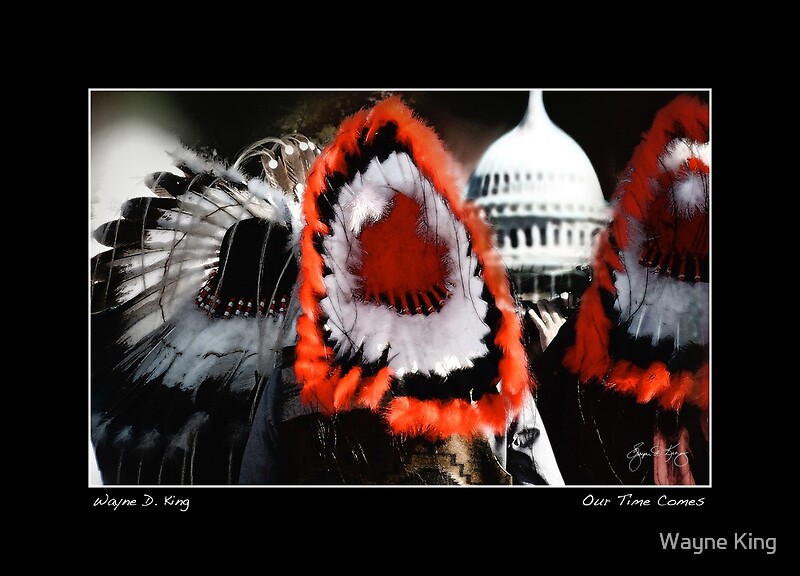
![]() |
| Our Time Comes |
Here is the first question I asked myself (hey give me a break I'm Iroquois!) How does the value of the land taken from Native American people in the conquest of the US relate to GNP today?
As far as I know, no one has done extensive academic research on this topic and for good reason. It would be almost impossible - without Big Data and a powerful computer - to figure out, given differing land values and differing time tables, to say nothing of the fact that knowing when a land transaction was actually voluntary (not very often). On the other hand there is enough data out there to do a "back of the envelope" calculation generally, so here goes:
Using very rough estimates and not including the land taken from Native American people prior to 1776 and also not including improvements on the land such as the towns established in Georgia and the Carolinas by tribes like the Cherokee. It is generally understood that since 1776 Native Americans have been moved from lands totaling 1.5 Billion acres to a small set of reservations dotted around the country. If you simply use the general value of an acre of land prior to the Gold Rush ($1.25) the 1.5 Billion acres had a rough value back then of 1.9 Billion dollars. Using another rough calculation, real dollar values, we can estimate that $1.00 in the early 1800s is roughly (very roughly as we have no data related to inflation before 1913) equivalent to about $49.00 today. Since we know that no land in California today sells for $49.00 per acre (Average 2012 California farm real estate values set an all-time record - $7200 per acre) we can be sure that this is a conservative number, the value of the theft of native lands is, at a minimum $87 Billion dollars. If we use the $7,200/acre value, the value - still conservative - is 10.1 Trillion dollars. A glance at an estimate of the total value of US land is $14.48 Trillion dollars. The numbers show a surprising correlation. While about 80% of the lands of America were taken from native people after 1776, the value of that land today represents 70% of the total value of "unimproved" real estate (land only) in the US.
OK but the way we measure the wealth of our nation is not by real estate value, its by GDP. So how do we figure out what portion of the nation's wealth has been generated from lands taken from Native American people?
Well, let's try this: 18% of GDP is generated by real estate activity. 70% of 18% is 12.6%. GDP in 2016 was 18.57 Trillion. 12.6% of 18.57T is 2.32 Trillion dollars or 12.5% of 2016 US GDP generated from the 1.5 Billion acres of land taken from Native Americans since 1776.
While this is a seat of the pants calculation - I suspect the actual numbers would be higher - and certainly subject to legitimate criticism as there are many variables in the cost and value of land across the USA, the point made is the same. A large portion of national wealth has grown from the lands that we expropriated from Native American Indians.
Native people have not sought reparations. The loss of culture and marginalization for them has been far more important and can never be remunerated. It would be a step in the right direction to at least recognize that a substantial portion of our bounty today can be attributed to the land their ancestors called home.
About Wayne D. King: Wayne King is an author,
artist, activist and recovering politician. A three term State Senator, he was
the 1994 Democratic nominee for Governor and most recently the CEO of MOP
Environmental Solutions Inc., a public company in the environmental cleanup
space. His art is exhibited nationally in galleries and he has published
three books of his images. His most recent novel "Sacred Trust" a
vicarious, high voltage adventure to stop a private powerline, has been published
on Amazon.com http://bit.ly/STPaper. He lives in Rumney at the base of Rattlesnake
Ridge and proudly flies both the American and Iroquois Flags. His website is: http://bit.ly/WayneDKing
-=-=-=-=-=-=-=-=-=-=-=-=-
If you know of better sources for the information on the back of my "envelope" I'd love to find out about them so that I can update this information. If you disagree with my points, I'd like to hear you, especially if you have a well thought out response and not just a snarky or snide remark. Lets have an honest dialog and we'll all benefit from it. wdk
Subscribe to:
Posts (Atom)